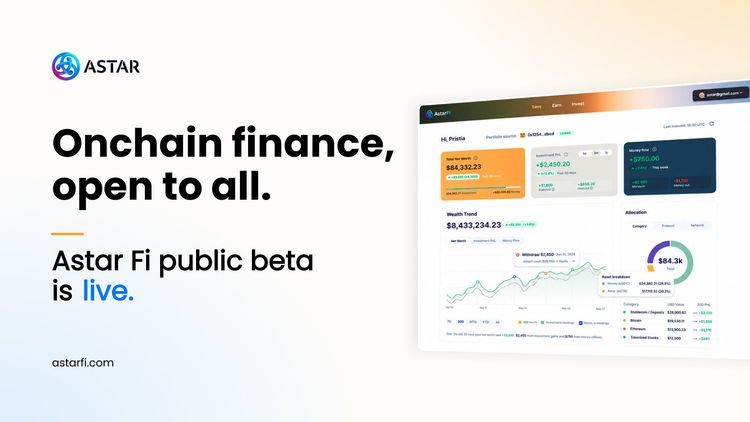
Astar Fi is an onchain personal finance manager, incubated by Astar Collective. It brings your onchain net worth into one clear view, then lets you earn and invest from the same place. Astar Fi’s public beta opened to everyone on 15 September, Astar Fi AI arrived on 8 October, and Robinhood Chain support followed on 22 October. The most common questions are about who Astar Fi is for, what it supports and how it relates to Astar Network and ASTR. This page answers them.
TL;DR
- Astar Fi is an onchain personal finance manager: see your net worth, then earn and invest on it in one place.
- It is built for people who manage their own money onchain, in a wallet they control.
- Astar Fi AI explains what you are looking at in the app, for education only.
- It is incubated by Astar Collective and is the first product in the Astar Stack.
- It supports Ethereum, Base and Robinhood Chain.
- ASTR is not needed to use Astar Fi. ASTR is the economic and governance token of the Astar ecosystem, used on Astar Network for staking and onchain governance.
- Astar Fi never takes custody of your funds.
- Get started at astarfi.com.
About Astar Fi
What is Astar Fi, and what problem does it solve?
Astar Fi is one place to see what you hold onchain and act on it. Onchain money tends to sit across different assets, protocols and positions, and understanding the full picture usually means moving between several apps. Astar Fi brings the holdings in your connected wallet into a single view: your net worth, your allocation, and what each asset is doing. From the same screen, you can put idle assets to work through curated yield vaults, or move into tokenized real-world assets such as gold. The app is built around three actions: Save, Earn and Invest.
Who is Astar Fi designed for?
Astar Fi is designed for people who manage their own money onchain. They hold assets in a wallet they control, make their own decisions, and want a clear view of their position before acting on it. The public beta is open to everyone.
Why use Astar Fi instead of other portfolio tools?
With Astar Fi, seeing a position, understanding its risk and acting on it all happen in one place. Astar Fi reads the positions you already hold on supported protocols, including vault shares and lending positions, and shows them as one net worth. From that view:
- Earn shows curated vaults with each vault's rating and the reasons behind it.
- Invest brings tokenized assets into the same portfolio.
- Astar Fi AI explains what you are looking at on each page, for education only.
The view, the risk and the action sit on the same screen, and every decision stays with you.
Which networks does Astar Fi support?
Astar Fi supports Ethereum, Base and Robinhood Chain. On Ethereum and Base, where it started, it covers supported assets, DeFi positions and curated vaults. On Robinhood Chain, added on 22 October, it covers supported stock tokens, ETFs and other assets in Save and Invest, plus 4 Morpho vaults in Earn.
Why does Astar Fi start with Ethereum and Base?
Astar Fi starts with Ethereum and Base because that is where its users and the markets it surfaces already are. Both networks host established DeFi: the lending markets, curated vaults and tokenized assets that Astar Fi brings into view. Starting there lets people use Astar Fi with the wallets and positions they already have. Save, Earn and Invest work across both networks, and coverage varies by asset. More networks will be added over time.
What can I do with Astar Fi on Robinhood Chain?
You can see your Robinhood Chain assets and positions next to the rest of your portfolio. In Earn, 4 Morpho vaults on Robinhood Chain carry the same rating details as every other vault. In Invest, you can act on stock tokens, ETFs and crypto on Robinhood Chain from the same place you track them.
Can I see my stock tokens on Robinhood Chain in Astar Fi?
Yes. Supported stock tokens you hold on Robinhood Chain show up next to your crypto and stablecoins in one portfolio view. Stock tokens are issued by third parties. They are not available in the US and are subject to restrictions in other jurisdictions.
Can I earn on my stablecoins with Astar Fi?
Yes. Earn lists curated stablecoin vaults on supported networks, each with a rating and the reasons behind it, so you can review a vault before you deposit from your own wallet. Funds supplied to any vault remain exposed to market and protocol risk, and yields vary over time.
What can I invest in through Astar Fi?
In Invest, you can act on crypto and tokenized assets across Ethereum, Base and Robinhood Chain. That includes tokenized stocks and ETFs on Ethereum via Ondo, which are not available to US, UK or EEA persons, stock tokens and ETFs on Robinhood Chain, and selected tokenized gold and silver. Coverage varies by asset.
Does Astar Fi hold my funds?
No. Astar Fi never takes custody of your funds. You connect a wallet you already control, and every action you take is approved from that wallet. Tokenized assets you buy through Invest land in your own wallet.
Astar Fi AI
What is Astar Fi AI?
Astar Fi AI is an assistant inside the Astar Fi app. It explains your portfolio, vaults and market data, using the page you are viewing and your supported portfolio for context. It is educational only. It never moves funds or gives buy or sell calls, and every decision stays with you. It has been available in Save, Earn and Invest since 8 October, and you can open it from any page with Ask Astar Fi AI.
Can Astar Fi AI explain my DeFi positions and their risks?
Yes. Ask it about what you are looking at in Save, Earn or Invest. It explains what sits underneath a vault, why a number moved and what a signal does and doesn’t say. For example, open a vault in Earn and ask “What’s driving this vault’s risk?”
How Astar Fi relates to Astar
How is Astar Fi related to Astar Network?
Astar Fi is a product incubated by Astar Collective, and Astar Network is Astar's own blockchain. They share the Astar name and do different jobs. Astar Fi is where you manage your onchain money. It supports Ethereum, Base and Robinhood Chain, so its activity takes place on those networks. Astar Network runs its own chain, separate from Astar Fi's activity.
What is the Astar Stack?
The Astar Stack is the suite of products Astar is building to bring real financial activity onchain. Its goal is to make saving, earning and monitoring money onchain as simple and secure as doing it anywhere else. Astar Fi is the first product in the Astar Stack.
Do users need ASTR to use Astar Fi?
No. You can use Astar Fi with the wallet you already have on Ethereum, Base or Robinhood Chain, and ASTR is not needed to use it. ASTR is the economic and governance token of the Astar ecosystem, used on Astar Network for staking and onchain governance.
What role does Astar Network play today?
Astar Network is Astar's own blockchain. It is where ASTR is used for staking and onchain governance, and it hosts the applications built on it. Astar Fi runs on Ethereum, Base and Robinhood Chain, so the two work side by side: Astar Network as Astar's chain, and Astar Fi as a personal finance product incubated by Astar Collective.
Using Astar Fi with Confidence
How do I get started with Astar Fi?
Getting started takes about a minute. Go to astarfi.com, sign in with Google or X, then connect the wallet where your assets live. A single signature confirms the wallet is yours, and your holdings appear in one view. Astar Fi runs at astarfi.com and will never ask for your seed phrase.
What do the vault ratings in Astar Fi mean?
A vault's rating is a way to compare risk, shown together with the factors behind it. When you open a vault in Earn, you can see:
- who curates it
- where its funds are supplied
- the quality of its collateral
- how much liquidity is available
The reasons for each rating are written out in plain terms. Coverage is deliberately selective, and a rating can be lowered, or deposits paused, when conditions change. Funds supplied to any vault remain exposed to market and protocol risk, and yields vary over time.
Where can I learn more?
Astar Fi is open to everyone at astarfi.com. Product updates are shared on @Astar_Fi on X.
Last updated: 23 October 2026