There is a part of onchain finance that rarely makes the headlines. Coverage tends to follow the whales, the funds and the day traders. Between them sits the middle: wallets holding $50,000 to $2 million in stablecoins.
We wanted to know what that money is doing. So in mid-October, we took a snapshot of Ethereum and Base wallets in that range. We left out exchanges, bridges, institutions and smart contracts, so these are regular wallets, not money held by a platform on its users' behalf.
Four numbers stand out.
Key takeaways
- About 91,000 wallets hold $23.4 billion in stablecoins in this range.
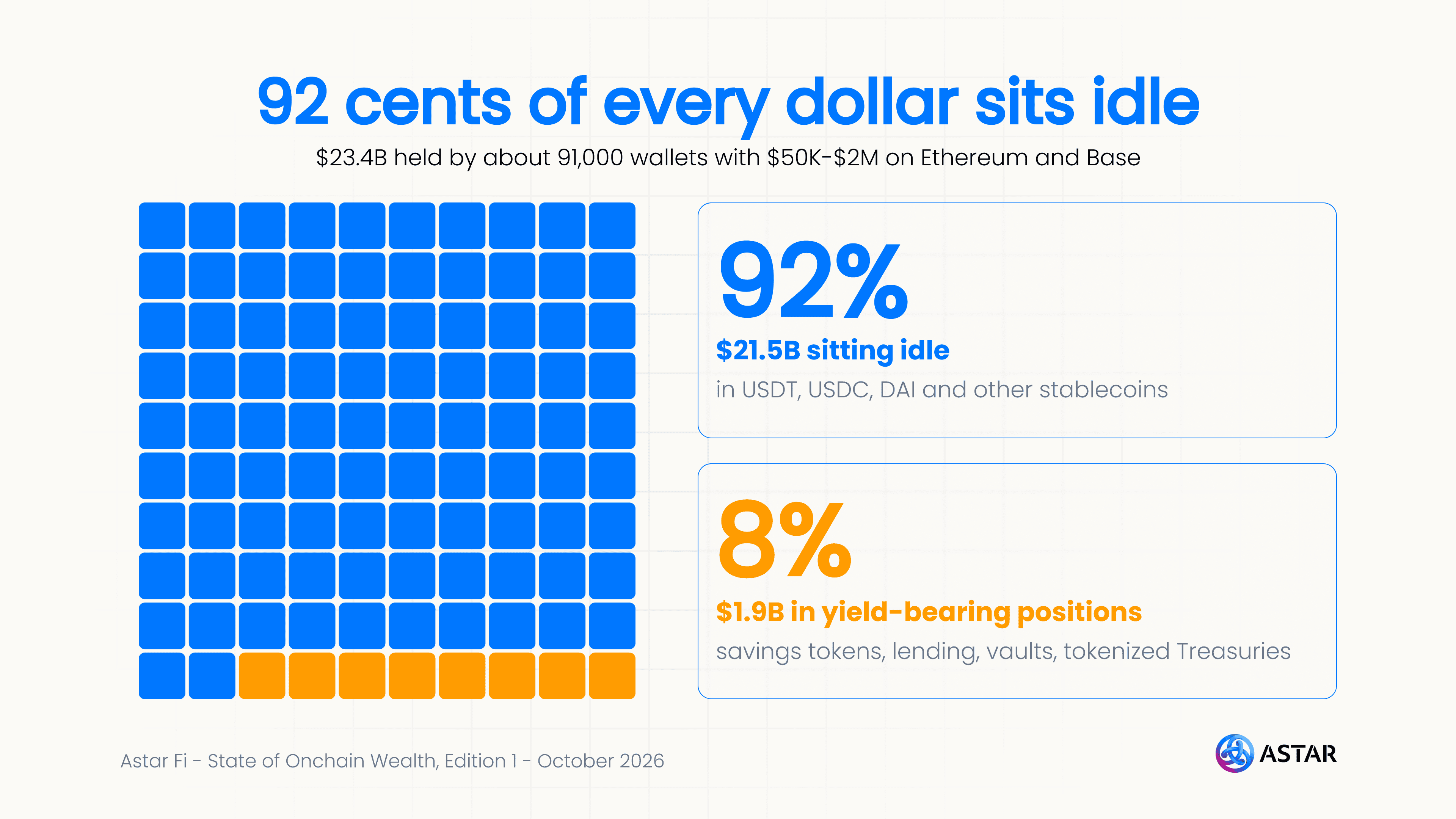
- $21.5 billion of it (92%) sits in plain stablecoins such as USDT and USDC.
- Fewer than 1 in 10 of these wallets holds any of the yield-bearing positions we track.
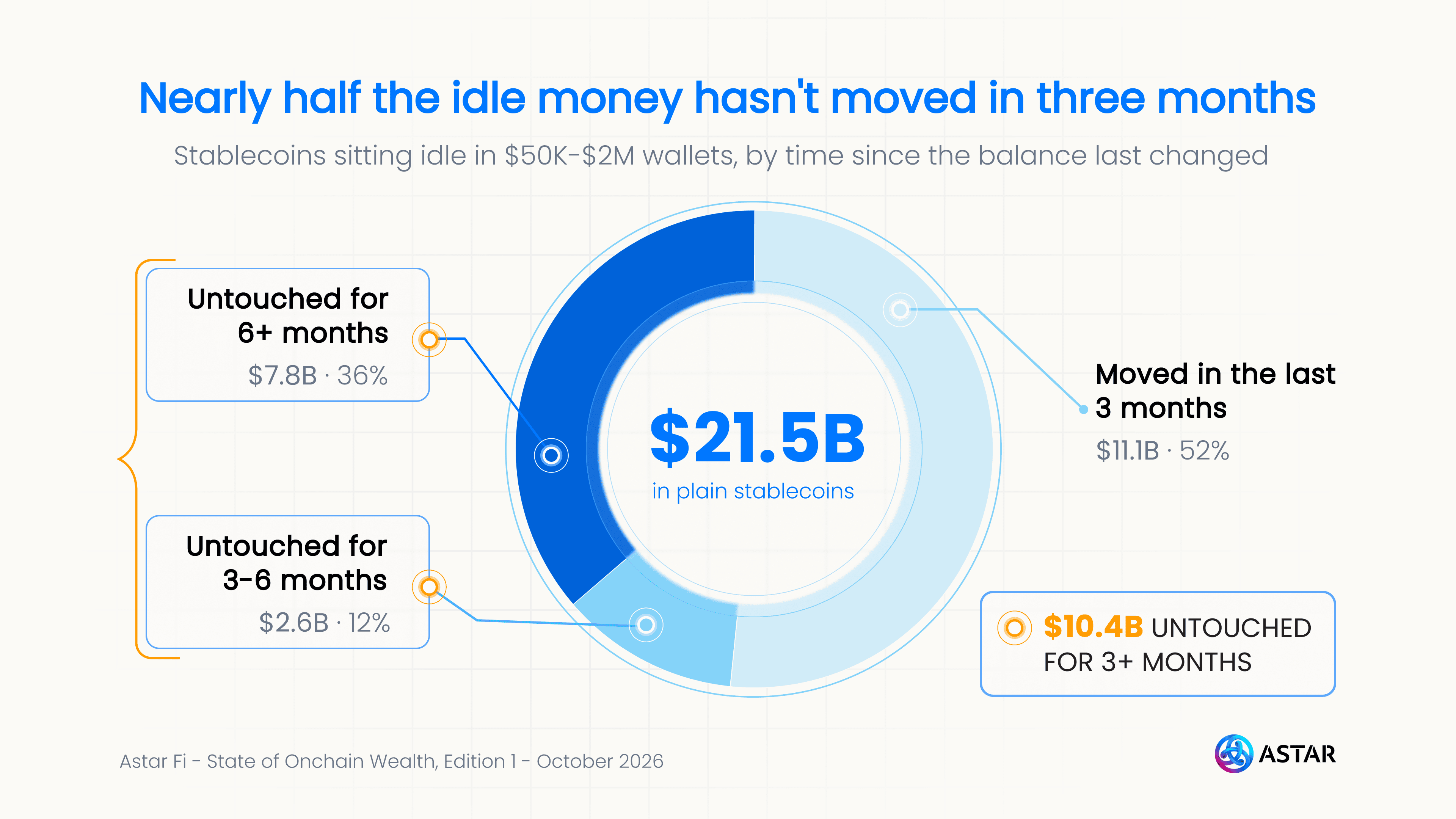
- About half of those plain-stablecoin dollars, $10.4 billion, have not moved in 90 days.
The $23.4 billion middle
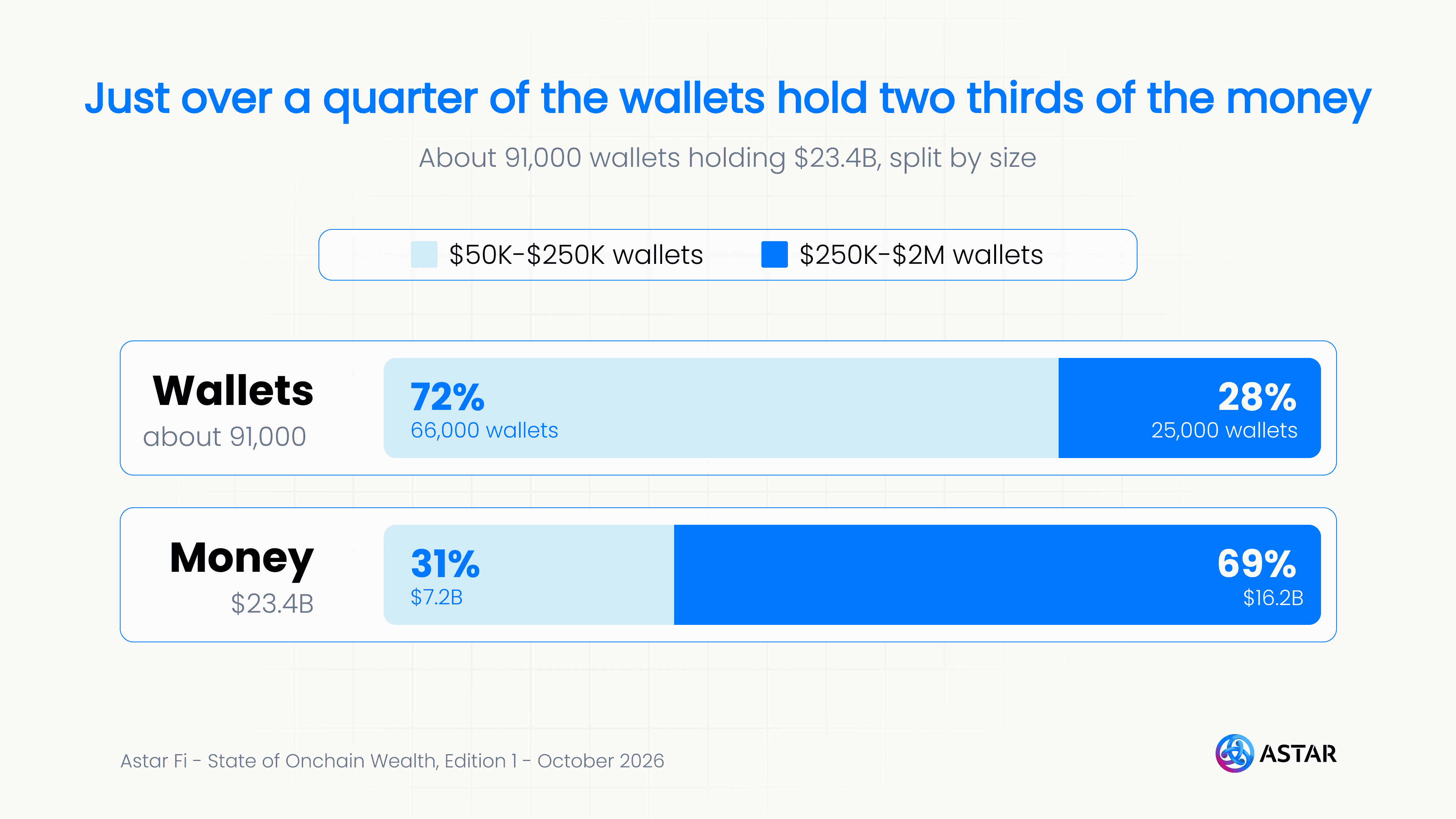
About 91,000 wallets sit in this range, holding $23.4 billion between them.
The weight is at the top. The 25,000 wallets holding $250K to $2M account for $16.2 billion, more than two thirds of the total. The other 66,000, holding $50K to $250K, account for $7.2 billion.
And it is mostly on Ethereum. 17% of these wallets hold stablecoins on Base, but Base carries only about 2% of the plain-stablecoin dollars.
Nine in ten dollars sit in plain stablecoins
Of that $23.4 billion, $21.5 billion is held as plain stablecoins such as USDT, USDC and DAI, rather than in savings-rate tokens, lending positions, vault shares or tokenized Treasuries. That is about one in seven of the roughly $149 billion in USD stablecoins on Ethereum and Base.
Wallet by wallet, the picture holds. Only 8.2% of wallets in the range hold any of those positions. The share rises with balance, from 7.5% at $50K-$250K to 10.1% at $250K-$2M, but it stays low at every level (for comparison, wallets above $2M: 12%).
Unmoved for months
A large share of this money stays put. 44% of wallets in the range have not changed their plain-stablecoin balance in 90 days; together they hold $10.4 billion. That is about half of all plain-stablecoin dollars in the range. Stretch the window to 180 days and it is still 33% of wallets, holding $7.8 billion.
Smaller and larger holders look alike: 43% and 46% respectively are unchanged after 90 days.
Why would money sit still?
The data shows where stablecoins sit. It can't show why, and there are good reasons to hold them plain:
- Dry powder. Waiting for an entry: a dip in crypto, or the right price on a tokenized asset.
- Liquidity. Money that needs to be available on short notice.
- Simplicity and risk. Not every holder wants smart-contract or counterparty exposure on their cash.
- Positions elsewhere. Yield held on other chains, or in products this snapshot does not cover.
One person can use several wallets, and some wallets are shared.
Plain does not mean wrong, but it is not free: USDT and USDC track the dollar, so inflation slowly reduces what each dollar buys.
Which raises a simple question for anyone holding stablecoins: do you know exactly where yours sit, and what they are doing?
Where does your own money sit?
For most holders, that is hard to answer at a glance. Balances are spread across tokens and apps, and a wallet shows them as a flat list.
Astar Fi, incubated by Astar Collective, brings a wallet's supported assets on Ethereum, Base and Robinhood Chain into one view, from plain stablecoins to vault and lending positions. From the same screen, you can save, earn and invest.
$21.5 billion in this range sits idle.
See your own number on Astar Fi → astarfi.com
Methodology and data sources
Public onchain balances on Ethereum and Base from Dune, snapshot of October 16, 2026, 06:12 UTC (Ethereum block 26,203,218; Base block 52,670,892), priced with Dune's latest USD prices (vault shares without a market price are valued at their underlying). A wallet's stablecoin wealth is its plain USD stablecoins plus yield-bearing stablecoin positions, summed across both chains; the $50K-$2M range applies to that combined total. Smart contracts are excluded, including Safes and smart-contract accounts, which likely understates Base; including Safes moves the idle share from 91.8% to 91.4%. Exchange deposit addresses and wallets labelled as exchanges, bridges or institutions (Dune labels) are excluded; unlabelled entities may remain. "Idle" means held in plain stablecoins, outside the yield-bearing positions tracked here. "Unmoved" means no change to any plain-stablecoin holding of $1 or more over the window, so funds moved out and back count as moved. Wallets above $2M are shown for comparison only. Some yield positions are not counted, so the idle share is an upper bound. Figures are rounded; shares use unrounded values. Stablecoin supply: DefiLlama, October 16, 2026. Full token list and queries: https://dune.com/astar_network/state-of-onchain-wealth. The public query returns current data; Edition 1 is the October 16 snapshot. A wallet is not a person. Not financial advice.
How to cite: Source: Astar Fi, State of Onchain Wealth, Edition 1 (October 2026), https://astar.network/blog/state-of-onchain-wealth-255/
About Astar Fi
Astar Fi is an onchain personal finance manager, incubated by Astar Collective.
- Earn: selected vaults, lending markets and tokenized yield products, each with a risk rating and the parameters behind it.
- Invest: buy crypto and tokenized assets without leaving your portfolio.