
Table of Contents
Astar is entering a new phase in how ASTR supply is structured.
Originally introduced as part of the Road to Astar Evolution Phase 2 and refined through community discussion via the Astar Collective, Tokenomics 3.0 is now live. This update introduces emission decay, reduces the inflation ceiling, and establishes a long-term supply convergence target for ASTR. Together, these changes clarify how issuance works today and how it evolves over time.
TL;DR
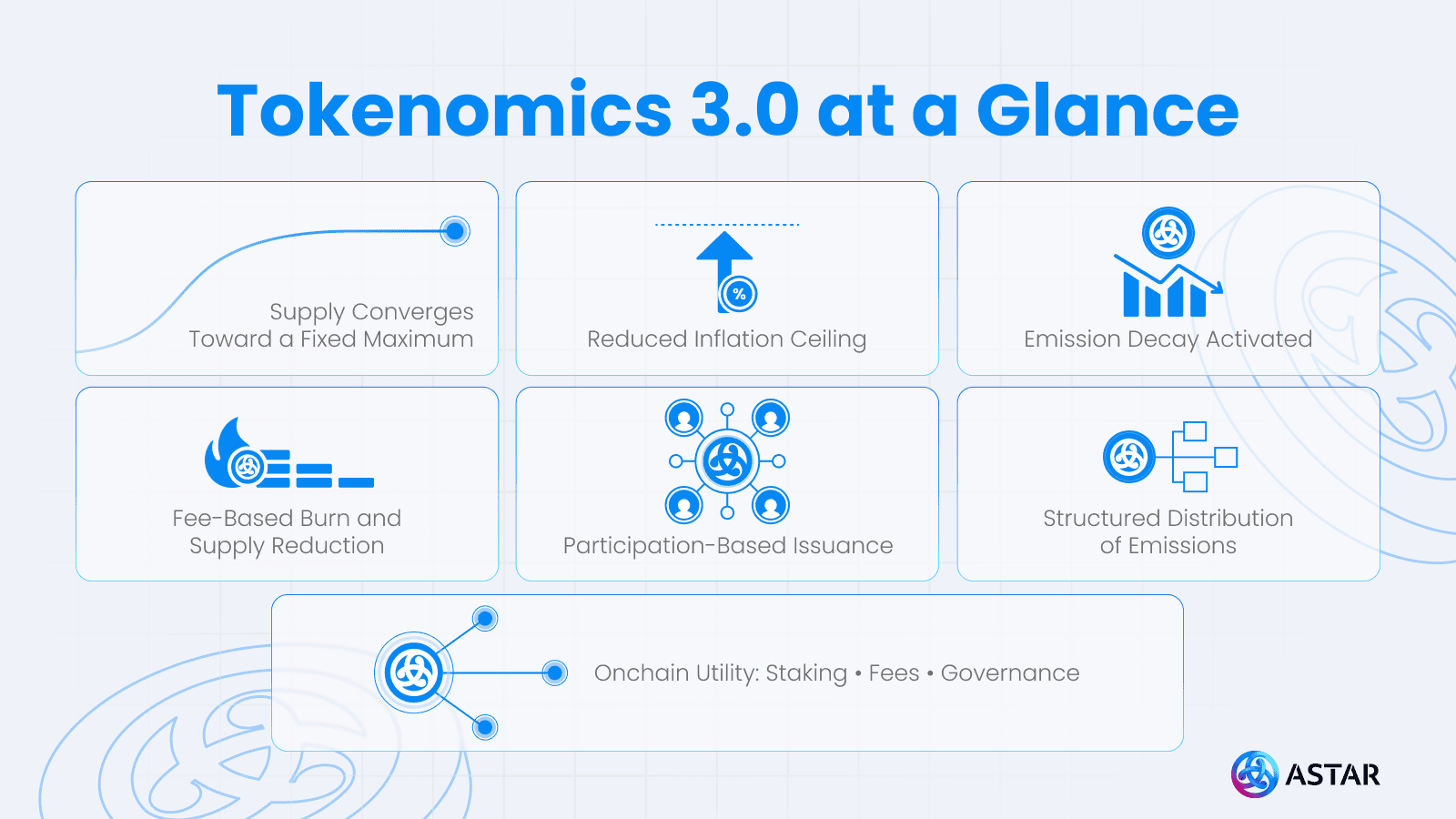
- ASTR now converges toward a fixed maximum supply of approximately 10 billion tokens.
- Actual inflation is currently 3%, depending on staking participation.
- The maximum yearly inflation ceiling has been reduced from 7% to 5.5%.
- Emission decay is now active, meaning new issuance decreases gradually over time.
- Refined through the Astar Collective following community discussion.
- Burn mechanisms such as Burndrop can reduce total supply further.
Why Tokenomics 3.0
Astar is operating with a dynamic inflation model, where emissions adjust automatically based on staking participation. This ensures that emissions respond to real network conditions rather than remaining fixed.
What the model did not provide was a supply convergence target. Tokenomics 3.0 introduces that objective.
By reducing the inflation ceiling and activating emission decay, the network now operates within a structured supply framework where total ASTR supply converges toward a fixed maximum.
ASTR Supply Now Converges Toward 10 Billion
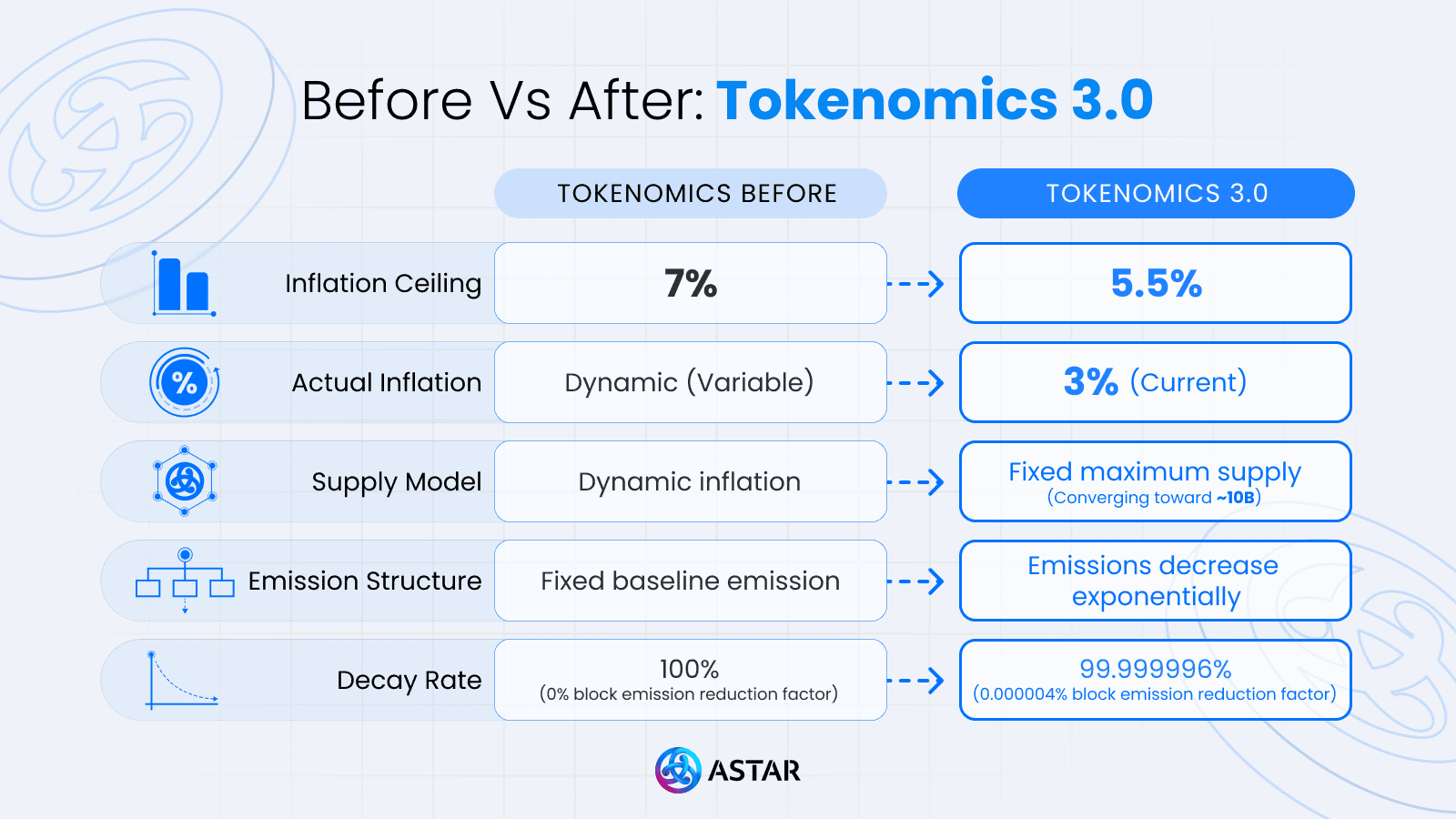
With emission decay now active, the number of new ASTR issued per block gradually decreases over time. Emissions reduce continuously, which means the rate of supply growth slows each year.
Under the current parameters, total ASTR supply converges toward approximately 10 billion tokens.
The 10B figure represents the theoretical maximum under the decay model. It reflects the long-term outcome of gradually decreasing emissions built into the chain. Burn mechanisms operate independently of this model, meaning the eventual total supply may be lower than 10 billion ASTR.
The supply ceiling is enforced algorithmically by the protocol.
Lower Maximum Inflation
Tokenomics 3.0 reduces the maximum yearly inflation ceiling from 7% to 5.5%.
This ceiling defines the upper bound of inflation under ideal participation conditions. Actual ASTR inflation depends on staking participation and is currently 3%.
Under current supply assumptions, the update reduces annual emissions by approximately 129 million ASTR and lowers the overall emission ceiling by 21.4% compared to previous parameters.
Parameter Changes
| Parameter | Current | Proposed |
|---|---|---|
| Max yearly inflation | 7% | 5.5% |
| Treasury allocation | 5% | 5% |
| Collator allocation | 3.2% | 3.2% |
| dApp reward allocation | 13% | 13% |
| Base staker allocation | 10% | 15.8% |
| Adjustable staker allocation | 55% | 63% |
| Bonus allocation* | 13.8% | 0% |
| Ideal staking rate | 50% | 50% |
| Decay rate | 100% (inactive) | 99.999996% |
*The bonus allocation is reallocated to the base staker and adjustable staker allocations as part of the dApp Staking Revamp.
New tokens continue to be issued, with issuance now operating within clearly defined limits.
Dynamic Inflation Remains Active
Tokenomics 3.0 continues to operate with participation-based inflation adjustments.
Inflation continues to adjust based on staking participation, with a target staking ratio of ~50%. If participation shifts away from that level, emissions adjust within defined bounds.
This ensures that staking rewards remain participation-driven, while emission decay guides long-term supply convergence.
The system remains responsive in the short term and predictable in the long term.
Interaction With Burn Mechanisms
Burn mechanisms such as Burndrop permanently remove ASTR from circulation.
In addition, 80% of ASTR used for network gas fees is burned. Of the total transaction fees paid by users, 20% is allocated to collators and 80% is permanently removed from supply. As onchain activity increases, more ASTR is burned through this mechanism.
Since the 10 billion supply figure represents the maximum possible supply under emission decay, each token burned lowers the effective long-term supply. Emission decay and fee-based burns together shape how ASTR supply evolves over time.
What Tokenomics 3.0 Establishes
The network now operates with:
- A supply maximum of ~10 billion ASTR.
- A reduced maximum inflation ceiling of 5.5%.
- Continuous emission reduction through decay.
- Ongoing participation-based inflation adjustments.
ASTR issuance continues, with total supply following a predictable trajectory. Tokenomics 3.0 clarifies how issuance evolves from this point forward while preserving participation-based incentives across the network.
Closing
With Tokenomics 3.0 active, ASTR issuance now operates within clearly defined limits. The maximum supply converges toward 10 billion tokens, emissions decrease continuously over time, and participation-based rewards remain in place. This gives network participants a predictable framework for how ASTR supply evolves from this point forward.
For more information, please refer to this FAQ.